
Conversion Metrics Explained: Driving Shopify Sales Success
Most American online stores lose nearly 98 out of every 100 visitors before a sale ever happens. In today’s fast-paced eCommerce market, even the smallest change in conversion metrics can determine whether your Shopify store grows or stalls. By digging deeper into these powerful numbers, you unlock the secrets hidden in customer actions and discover clear strategies that move your business forward with confidence.
Table of Contents
- What Are Conversion Metrics in eCommerce
- Types of Conversion Metrics for Shopify Stores
- How AI-Powered A/B Testing Improves Metrics
- Interpreting Key Performance Indicators Accurately
- Common Pitfalls and Misconceptions in Conversion Analysis
Key Takeaways
| Point | Details |
|---|---|
| Understanding Conversion Metrics | Conversion metrics are critical for evaluating eCommerce performance and guiding strategic improvements. |
| Focus on Key Metrics | Essential metrics include Conversion Rate, Average Order Value, and Cart Abandonment Rate, which illuminate customer behavior. |
| Leverage AI for Optimization | AI-powered A/B testing can significantly enhance conversion metrics, enabling rapid and data-driven improvements. |
| Contextualize KPI Interpretation | Accurate interpretation of KPIs involves analyzing metrics with context and understanding their interrelationships. |
What Are Conversion Metrics in eCommerce
Conversion metrics represent the key performance indicators that measure how effectively an online store transforms website visitors into paying customers. In the competitive world of Shopify eCommerce, these metrics provide critical insights into sales performance and customer behavior. Understanding conversion metrics is fundamental to strategic business growth.
At its core, conversion rate represents the percentage of website visitors who complete a desired action, such as making a purchase. Research examining purchase intention and website satisfaction reveals that conversion metrics are more than just numbers – they are a window into customer engagement and online store effectiveness. These metrics help store owners understand exactly how well their digital storefront is performing.
Typical conversion metrics in Shopify eCommerce include:
- Conversion Rate: Percentage of visitors making a purchase
- Average Order Value: Total revenue divided by number of orders
- Cart Abandonment Rate: Percentage of shoppers who add items to cart but do not complete purchase
- Customer Acquisition Cost: Total marketing expenses divided by number of new customers
- Return Customer Rate: Percentage of customers who make repeat purchases
By tracking these detailed metrics, Shopify store owners can identify specific areas for improvement and optimize their online shopping experience. Comprehensive analytics help evaluate overall business performance and guide strategic decision-making.
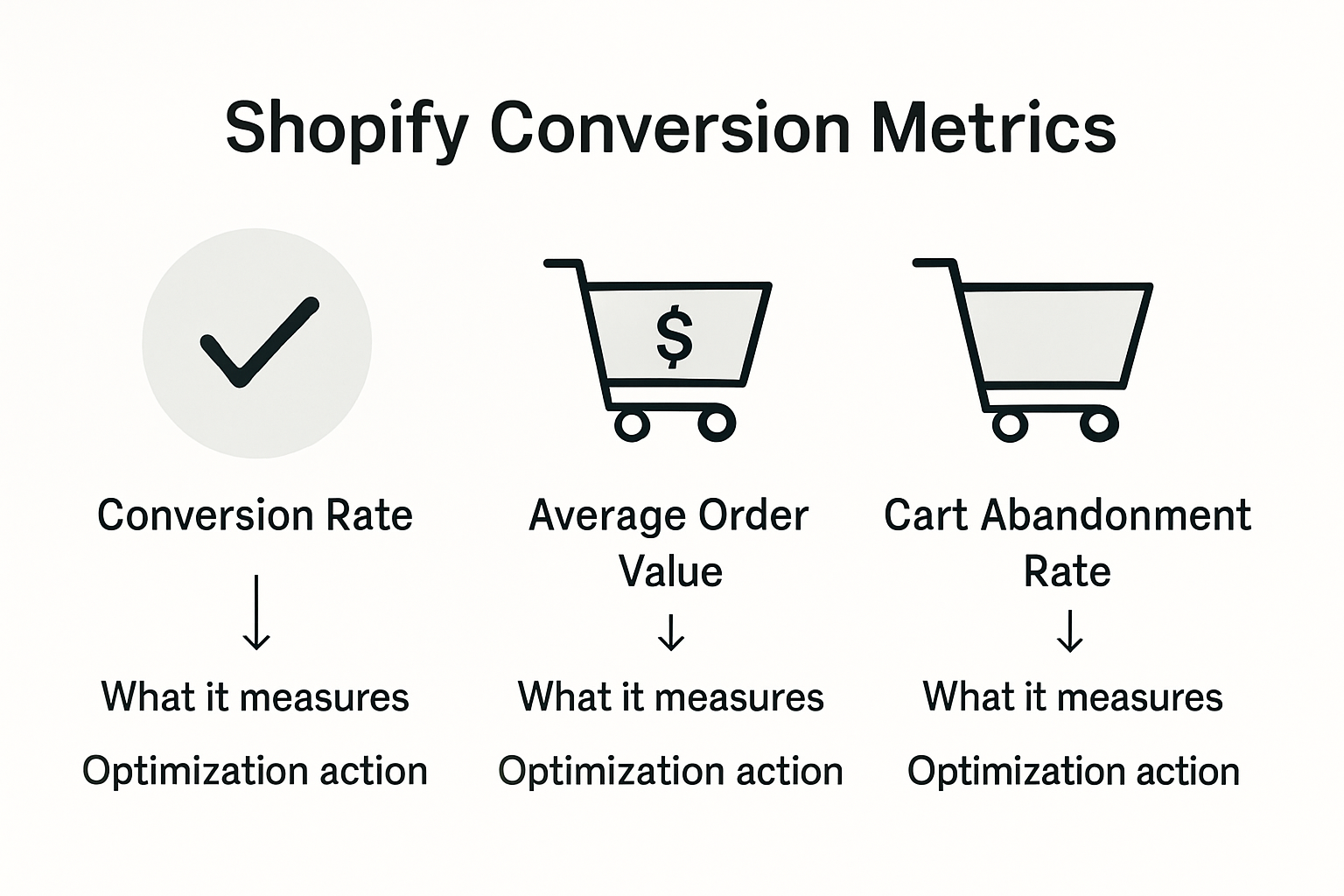
Here’s a quick summary of how key conversion metrics contribute to eCommerce success:
| Metric | Business Insight Provided | Common Optimization Action |
|---|---|---|
| Conversion Rate | Measures purchase effectiveness | Improve landing pages |
| Average Order Value | Reveals spending per transaction | Upsell higher-value products |
| Cart Abandonment Rate | Identifies checkout drop-off | Simplify checkout process |
| Customer Acquisition Cost | Tracks marketing investment | Refine ad targeting, reduce spend |
| Repeat Purchase Rate | Shows customer loyalty | Launch loyalty programs |
Pro Tip: Start by tracking your conversion rate consistently, establishing a baseline measurement before implementing any optimization strategies to understand your true performance improvements.
Types of Conversion Metrics for Shopify Stores
Shopify store owners rely on various conversion metrics to understand and optimize their online business performance. These metrics offer nuanced insights into customer behavior, sales effectiveness, and potential areas for improvement. By carefully tracking and analyzing these indicators, entrepreneurs can make data-driven decisions that directly impact their bottom line.
Conversion Rate stands as the most fundamental metric, representing the percentage of website visitors who complete a purchase. Detailed analysis of conversion rates reveals significant variations across different product categories and device types, highlighting the importance of targeted optimization strategies.
Key conversion metrics for Shopify stores include:
- Conversion Rate: Percentage of visitors completing a purchase
- Average Order Value (AOV): Total revenue divided by total number of orders
- Cart Abandonment Rate: Percentage of shoppers who add items to cart but do not complete purchase
- Revenue per Visitor: Total revenue divided by total website visitors
- Customer Acquisition Cost: Total marketing expenses divided by number of new customers acquired
- Repeat Purchase Rate: Percentage of customers making multiple purchases
These metrics provide a comprehensive view of store performance, allowing store owners to identify strengths and potential bottlenecks in their sales funnel. Each metric offers unique insights: conversion rate shows overall effectiveness, cart abandonment rate reveals potential checkout process issues, and customer acquisition cost helps understand marketing efficiency.
Pro Tip: Create a monthly dashboard tracking these key conversion metrics, comparing current performance against previous periods to identify trends and measure the impact of your optimization efforts.
How AI-Powered A/B Testing Improves Metrics
AI-powered A/B testing represents a revolutionary approach to optimizing Shopify store performance by leveraging advanced algorithms and machine learning techniques. This sophisticated method allows store owners to systematically test and improve various elements of their online presence, driving significant improvements in conversion metrics with unprecedented precision and efficiency.

Research exploring website relaunch strategies demonstrates how strategic A/B testing can dramatically enhance conversion rates, providing data-driven insights that transform guesswork into calculated optimization. AI technologies enable businesses to analyze complex user interactions, identifying subtle patterns that traditional testing methods might overlook.
Key advantages of AI-powered A/B testing include:
- Rapid Iteration: Automatically generate and test multiple design variations
- Predictive Analysis: Forecast potential performance before full implementation
- Comprehensive Insights: Analyze user behavior across multiple dimensions
- Personalized Optimization: Adapt testing strategies to specific store characteristics
- Reduced Manual Effort: Automate complex testing processes
Advanced optimization techniques can significantly impact critical e-commerce metrics like gross merchandise value, demonstrating how sophisticated AI testing approaches go beyond simple webpage modifications. By continuously learning from user interactions, AI-powered testing systems can make increasingly nuanced recommendations that incrementally improve store performance.
The table below compares traditional versus AI-powered A/B testing for Shopify stores:
| Approach | Testing Speed | Insights Gained | Manual Effort |
|---|---|---|---|
| Traditional A/B | Slower, one test at once | Limited, often basic patterns | High, setup required |
| AI-Powered A/B | Rapid, many variants | In-depth, cross-segment analysis | Low, mostly automated |
Pro Tip: Start with small, measurable tests focusing on high-impact elements like product descriptions, call-to-action buttons, or checkout page design to build confidence in your AI-powered optimization strategy.
Interpreting Key Performance Indicators Accurately
Accurately interpreting key performance indicators (KPIs) is critical for Shopify store owners seeking to understand and improve their online business performance. Raw numbers can be misleading without proper context and analytical depth, making it essential to develop a sophisticated approach to metrics interpretation.
Advanced modeling techniques for conversion rate prediction offer nuanced insights into performance evaluation, revealing that context matters more than absolute numbers. Successful interpretation requires understanding the interplay between different metrics and recognizing the unique characteristics of your specific Shopify store.
Critical considerations for accurate KPI interpretation include:
- Contextual Analysis: Compare metrics against industry benchmarks
- Longitudinal Tracking: Examine performance trends over time
- Segment-Specific Insights: Break down metrics by customer segments
- Correlation Examination: Understand relationships between different performance indicators
- Qualitative Complementation: Combine quantitative data with user feedback
Comprehensive research into user interactions provides deeper understanding of conversion metric complexities, highlighting that each metric tells only part of the story. Successful store owners go beyond surface-level number reading, diving into the underlying patterns and motivations driving their performance metrics.
Pro Tip: Develop a monthly dashboard that not only displays raw numbers but also includes trend lines, comparative analysis, and potential hypotheses explaining performance fluctuations.
Common Pitfalls and Misconceptions in Conversion Analysis
Conversion analysis represents a complex landscape where seemingly straightforward metrics can hide nuanced insights and potential misinterpretations. Shopify store owners must navigate carefully to avoid drawing incorrect conclusions that could lead to misguided strategic decisions.
Quantitative research reveals significant challenges in e-commerce website evaluations, highlighting potential pitfalls in heuristic analysis, demonstrating that surface-level interpretations can be fundamentally misleading. Successful conversion analysis requires a sophisticated approach that goes beyond simple numerical comparisons.
Common misconceptions in conversion analysis include:
- Sample Size Fallacy: Drawing conclusions from statistically insignificant data sets
- Correlation vs. Causation: Mistaking coincidental relationships for causal connections
- Narrow Time Frame Bias: Analyzing performance over too short a period
- Segment Homogenization: Treating all customer groups as identical
- Metric Tunnel Vision: Focusing on a single performance indicator
Advanced studies expose critical challenges in conversion rate estimation, including complex issues like sample selection bias and data sparsity, demonstrating the intricate nature of accurate performance measurement. Sophisticated store owners recognize that true insights emerge from comprehensive, nuanced analysis rather than simplistic number counting.
Pro Tip: Implement a rigorous data validation process that includes cross-referencing multiple metrics, establishing confidence intervals, and maintaining a healthy skepticism toward initial interpretations.
Unlock Your Shopify Store’s Full Potential with AI-Powered Conversion Optimization
The article highlights the critical challenge Shopify store owners face in accurately interpreting conversion metrics and overcoming common pitfalls such as slow A/B testing and limited insight generation. Achieving a high conversion rate requires rapid, sophisticated experimentation without wasting resources on manual, complex setups. If you want to drive real sales growth and reduce cart abandonment by improving your checkout flow or product pages, understanding key metrics like conversion rate and average order value is essential. Automagic.li directly addresses these pain points by delivering ready-made, high-impact A/B tests tailored by AI to your store’s unique design with zero coding required.
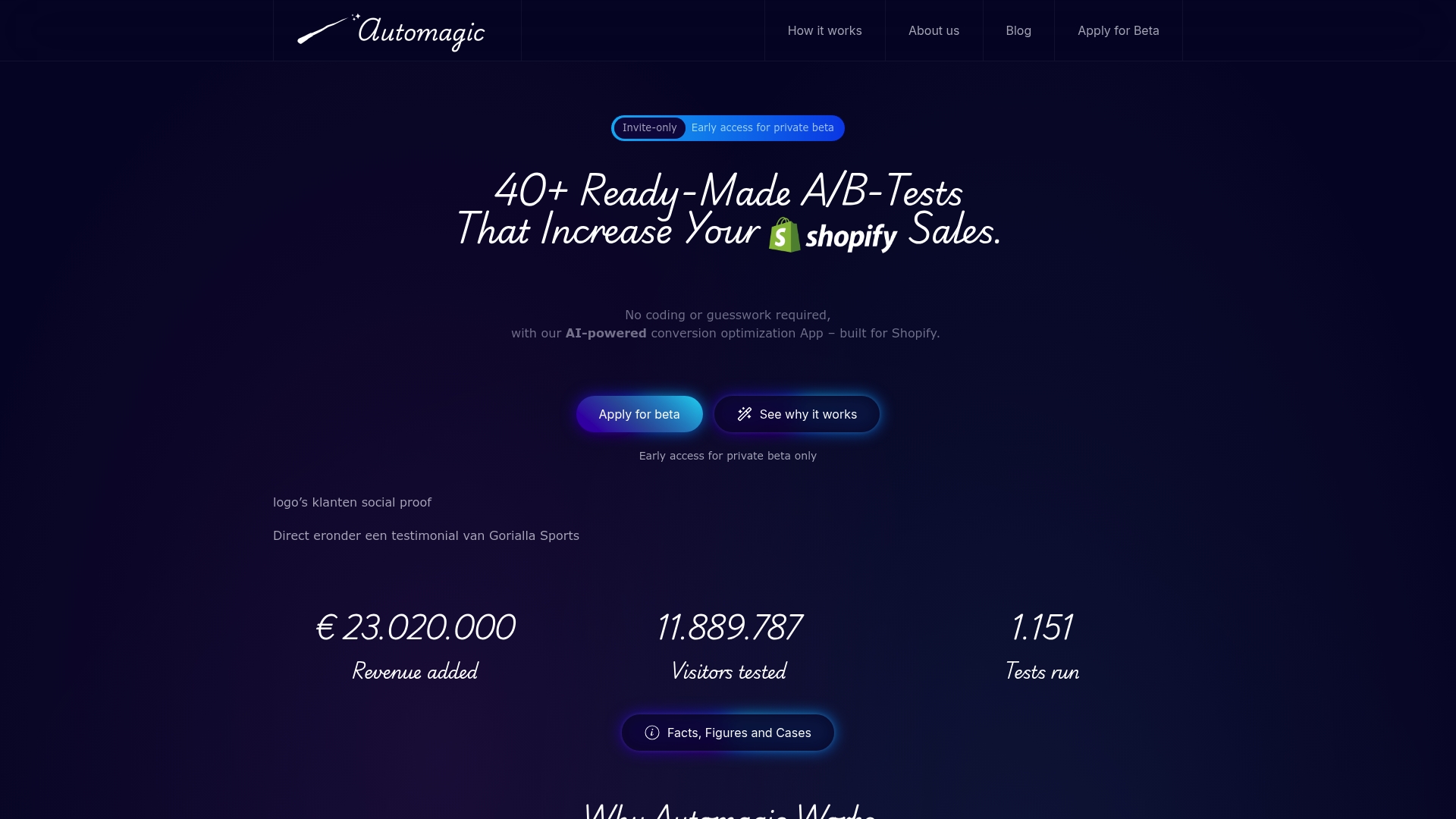
Take control of your eCommerce success today with Automagic.li, a platform designed to empower Shopify entrepreneurs like you to make data-driven decisions faster and easier. Benefit from a library of over 40 pre-tested variations that improve your store’s performance based on proven metrics such as repeat purchase rate and customer acquisition cost. Don’t get stuck in the trap of slow traditional testing methods or inconsistent metric interpretations. Visit Automagic.li now to start transforming your conversion metrics into powerful sales results with AI-powered A/B testing that makes advanced optimization accessible and stress-free.
Frequently Asked Questions
What are conversion metrics in eCommerce?
Conversion metrics in eCommerce are key performance indicators that measure how effectively an online store turns website visitors into paying customers, providing insights into sales performance and customer behavior.
How is the conversion rate calculated?
The conversion rate is calculated by dividing the number of visitors who complete a desired action (such as making a purchase) by the total number of visitors, then multiplying by 100 to get a percentage.
Why is understanding average order value important for my Shopify store?
Understanding average order value (AOV) is important because it reveals the average revenue generated per transaction, allowing store owners to identify opportunities for upselling and improving overall revenue.
How can AI-powered A/B testing help improve my store’s conversion metrics?
AI-powered A/B testing can improve conversion metrics by systematically testing different elements of your store, providing in-depth insights, and allowing for rapid iteration, leading to optimized user experiences that drive more conversions.