
Ecommerce A/B Testing: Boost Shopify Conversions Fast
Over 60 percent of American Shopify stores still rely on gut instinct instead of proven testing methods for website changes. In a digital market where every click could mean a sale, this approach leaves real revenue on the table. Understanding how ecommerce A/B testing works empowers American store owners to make confident, data-backed improvements that drive more conversions and repeat buyers without expensive redesigns.
Table of Contents
- Defining Ecommerce A/B Testing For Shopify
- Types Of Tests Used In Online Stores
- How AI Powers No-Code Testing Platforms
- Interpreting Results And Measuring Impact
- Avoiding Common A/B Testing Pitfalls
Key Takeaways
| Point | Details |
|---|---|
| Data-Driven Decisions | A/B testing enables Shopify store owners to make informed choices that enhance performance and user experience through systematic experiments. |
| Continuous Optimization | Embracing A/B testing as an ongoing strategy helps uncover insights that lead to significant improvements in conversion rates and profitability. |
| AI Integration | AI-powered no-code testing platforms simplify A/B testing, allowing store owners to optimize without needing extensive technical skills. |
| Avoiding Common Errors | Maintaining statistical rigor and methodological consistency is crucial to achieving valid and actionable A/B testing results. |
Defining Ecommerce A/B Testing for Shopify
A/B testing is a strategic method for Shopify store owners to scientifically improve website performance and conversion rates. This data-driven approach allows online businesses to systematically compare two different versions of a webpage or app element to determine which one generates better results. By experimentally testing variations, store owners can make informed decisions that directly impact sales and user experience.
At its core, A/B testing involves creating two distinct versions of a specific webpage element – such as product descriptions, checkout buttons, images, or pricing displays. One version (A) serves as the control, while the other version (B) introduces a strategic modification. Traffic gets randomly split between these versions, with performance metrics like click-through rates, conversion rates, and average order value carefully tracked. This method eliminates guesswork by providing concrete, statistically significant data on what resonates most with your specific Shopify store’s audience.
The mechanics of A/B testing for Shopify stores are straightforward yet powerful. Store owners can test critical components like product page layouts, call-to-action button colors, product descriptions, and pricing strategies. Each test typically follows a structured process: develop a hypothesis, create test variations, split traffic, collect data, and analyze results. Successful A/B testing requires patience, statistical rigor, and a commitment to continuous optimization. The goal isn’t just incremental improvements, but discovering game-changing insights that can significantly boost your store’s performance and profitability.
Key advantages of A/B testing for Shopify stores include:
- Minimizing risk by testing changes before full implementation
- Understanding customer preferences through data-driven insights
- Improving conversion rates without expensive redesigns
- Making objective, evidence-based design decisions
- Reducing customer friction points in the purchasing journey
By embracing A/B testing, Shopify entrepreneurs transform website optimization from a guessing game into a precise, strategic science.
Types of Tests Used in Online Stores
Shopify store owners have several strategic A/B testing approaches to optimize their online performance. A/B testing represents the foundational method, where two versions of a single webpage element are compared directly. However, more advanced testing techniques like multivariate testing provide deeper insights by examining multiple variables simultaneously. This allows store owners to understand complex interactions between different design elements and their collective impact on conversion rates.
The primary types of A/B tests for online stores include product page tests, checkout process tests, and design variation tests. Product page tests might involve comparing different image layouts, product description formats, or pricing presentation strategies. Checkout process tests focus on elements like button colors, form field designs, and payment gateway interfaces. Design variation tests explore broader aesthetic changes, including color schemes, navigation structures, and overall user interface configurations that could influence customer engagement.

Moredern web-based experiments enable businesses to conduct rigorous testing across diverse user populations, reducing traditional research limitations. Online stores can now rapidly prototype and validate design hypotheses with unprecedented speed and statistical reliability. Advanced testing methods extend beyond simple binary comparisons, allowing sophisticated analysis of user behavior, interaction patterns, and conversion triggers.
Key testing categories for Shopify stores include:
- A/B Testing: Direct comparison of two page variants
- Multivariate Testing: Simultaneous evaluation of multiple elements
- Split URL Testing: Comparing entirely different webpage designs
- Redirect Tests: Routing traffic to different page versions
- Personalization Tests: Tailoring experiences for specific user segments
Successful online stores recognize that continuous testing is not just a strategy, but a fundamental approach to understanding and optimizing digital customer experiences.
How AI Powers No-Code Testing Platforms
Artificial Intelligence has revolutionized A/B testing for Shopify store owners by dramatically simplifying the complex process of website optimization. Advanced AI methodologies are transforming online marketplace experimentation, enabling store owners to conduct sophisticated tests without requiring deep technical expertise. Traditional A/B testing demanded significant coding skills and statistical knowledge, but AI-powered platforms have democratized this process, making powerful optimization strategies accessible to everyone.
The core innovation of AI-driven no-code testing platforms lies in their ability to automate complex experimental design and analysis. Systematic research demonstrates how AI is streamlining experiment design and analysis processes, reducing the manual effort required to generate meaningful insights. These intelligent platforms can automatically generate test variations, predict potential performance outcomes, and provide statistically robust recommendations without requiring users to write a single line of code.
AI-powered testing platforms leverage machine learning algorithms to continuously improve testing strategies. They can analyze historical performance data, understand user interaction patterns, and dynamically adjust test parameters in real-time. This means Shopify store owners receive not just static test results, but adaptive, intelligent recommendations that evolve with their unique customer base. The AI can identify subtle interaction effects, recommend optimal test configurations, and even predict potential conversion improvements before tests are fully executed.
Key capabilities of AI-powered no-code testing platforms include:
- Automatic Variation Generation: Creating multiple test scenarios without manual design
- Predictive Performance Modeling: Forecasting potential test outcomes
- Statistical Significance Analysis: Determining reliable results automatically
- Personalization Insights: Understanding unique user segment behaviors
- Continuous Learning: Improving testing strategies over time
By removing technical barriers, AI transforms A/B testing from a complex statistical exercise into an intuitive, accessible tool for driving ecommerce success.
Interpreting Results and Measuring Impact
Successful A/B testing for Shopify stores goes beyond simply running experiments – it requires a nuanced approach to interpreting results and understanding their true business impact. Advanced testing frameworks help store owners reframe experiments as strategic trade-offs between opportunity costs and potential gains, moving beyond simplistic statistical significance to real-world financial implications. This means evaluating not just whether a test variation performed better, but calculating its precise economic value to the business.
Statistical significance is just the beginning of meaningful result interpretation. Sophisticated incrementality test frameworks provide deeper insights into personalized user strategies, allowing store owners to understand not just aggregate performance, but how different user segments respond to specific changes. Successful interpretation requires looking beyond surface-level metrics like conversion rates to analyze more complex interaction effects, customer lifetime value, and long-term behavioral shifts triggered by seemingly minor design modifications.
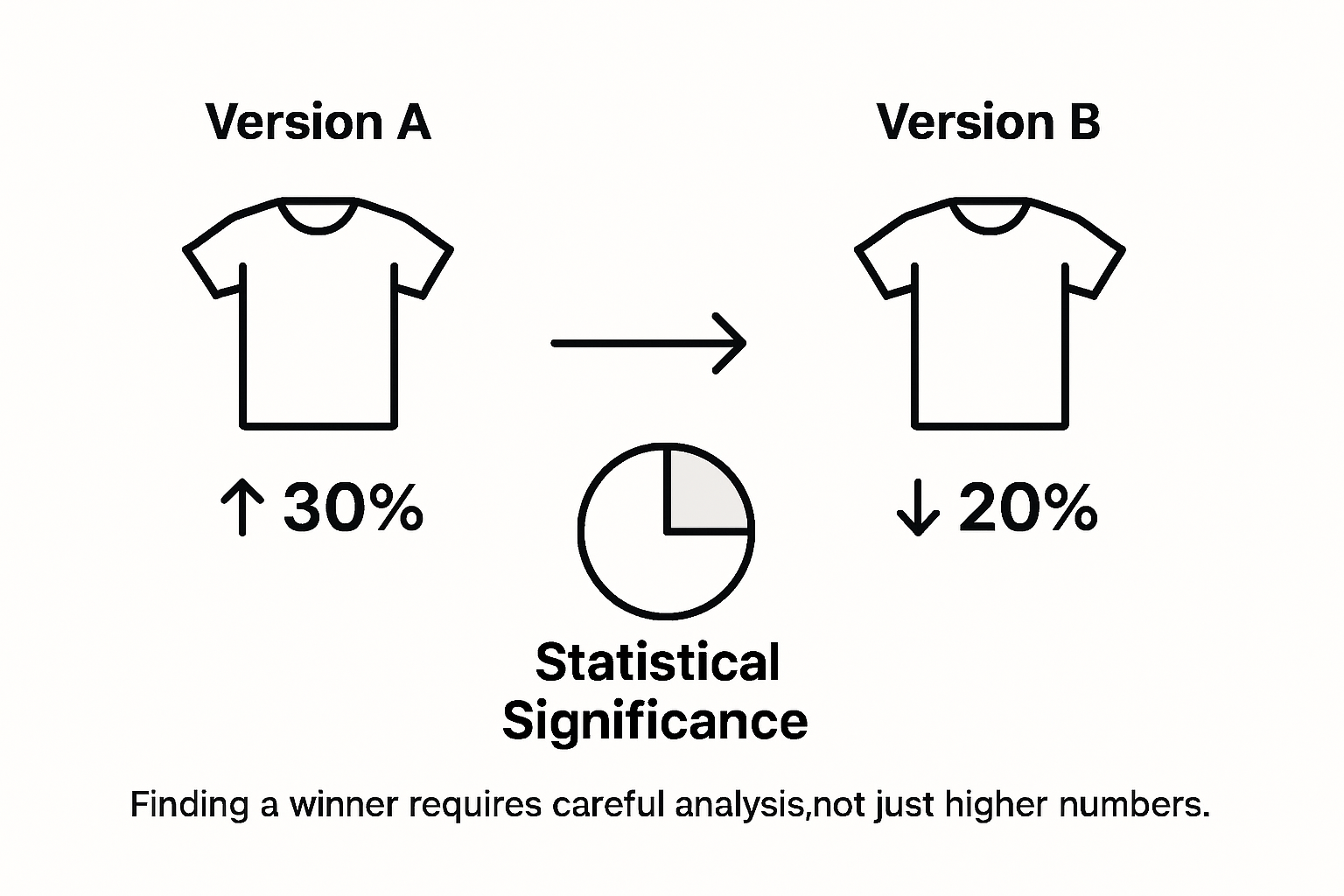
Key metrics for comprehensive A/B test result analysis include conversion rate, average order value, revenue per visitor, bounce rate, and customer engagement indicators. Store owners should establish a hierarchy of metrics, understanding that not all improvements are equal. A test might increase conversion rates but decrease average order value, or improve short-term metrics while potentially harming long-term customer retention. The most sophisticated A/B testing approaches create holistic measurement frameworks that balance immediate performance gains with sustainable business growth.
Essential steps in result interpretation include:
- Validate Statistical Significance: Confirm results aren’t random chance
- Calculate Economic Impact: Translate percentage improvements into actual revenue
- Segment Analysis: Understand variations across different customer groups
- Longitudinal Tracking: Monitor long-term effects beyond initial test period
- Contextual Evaluation: Consider broader business strategy and goals
Mastering result interpretation transforms A/B testing from a technical exercise into a powerful strategic tool for continuous business optimization.
Avoiding Common A/B Testing Pitfalls
A/B testing can transform Shopify stores, but only when executed with precision and strategic awareness. Systematic research reveals numerous challenges that can undermine the effectiveness of online experiments, highlighting the critical importance of understanding potential pitfalls before launching tests. Many store owners unknowingly compromise their results by making fundamental errors that can lead to misleading conclusions and wasted resources.
One of the most significant challenges in A/B testing involves statistical methodology and experimental design. Marketplace experimentation research identifies critical biases and low-power issues that can compromise test reliability, demonstrating that seemingly straightforward tests can produce deeply flawed insights. Common mistakes include insufficient sample sizes, premature test termination, ignoring statistical significance thresholds, and failing to account for external variables that might influence user behavior.
Successful A/B testing requires a disciplined approach that goes beyond simple metric tracking. Store owners must carefully control experimental conditions, ensure randomized user allocation, and maintain consistency in testing parameters. This means avoiding common traps like testing multiple variables simultaneously, selecting inappropriate metrics, overlooking seasonal variations, and drawing conclusions from statistically insignificant data. The most effective tests are those designed with rigorous scientific methodology, treating each experiment as a precise investigation rather than a casual observation.
Key pitfalls to avoid in Shopify A/B testing include:
- Sample Size Errors: Running tests with insufficient traffic
- Premature Conclusions: Stopping tests before reaching statistical significance
- Metric Myopia: Focusing on single metrics while ignoring holistic performance
- Confirmation Bias: Designing tests to validate preexisting assumptions
- Inconsistent Testing: Failing to maintain stable experimental conditions
Mastering A/B testing requires continuous learning, statistical literacy, and a commitment to methodical, data-driven decision-making.
Accelerate Your Shopify Store Success with AI-Powered A/B Testing
Many Shopify store owners face the challenge of improving conversion rates without the time or technical skills to develop complex, data-driven experiments. This article highlights that traditional A/B testing requires patience, statistical rigor, and often coding expertise, which can create barriers to making strategic, evidence-based decisions. Key pain points include avoiding common pitfalls like premature conclusions and insufficient sample sizes as well as the need for continuous optimization tailored to unique customer behaviors.
Automagic.li directly addresses these challenges by offering an AI-powered no-code platform designed specifically for Shopify stores. With a library of over 40 pre-tested A/B test variations ranked by impact and certainty, you can quickly deploy scientifically proven improvements without writing any code or hiring developers. Our intelligent platform automates the entire testing process from variation generation to statistical significance analysis, empowering you to make confident decisions that maximize your ecommerce revenue.
Ready to transform guesswork into precise, data-driven growth? Discover how Automagic.li leverages AI to simplify ecommerce A/B testing for Shopify entrepreneurs.
Take control of your store’s performance with instant access to high-impact A/B tests tailored to your design. Start optimizing conversions today at Automagic.li and experience faster, smarter growth without technical hassles.
Frequently Asked Questions
What is A/B testing in ecommerce?
A/B testing in ecommerce involves comparing two versions of a webpage or app element to determine which one performs better in terms of conversion rates and user engagement.
How can A/B testing improve my Shopify store’s performance?
By testing variations of elements like product descriptions, images, and button colors, A/B testing provides data-driven insights that help optimize your store, ultimately leading to higher conversion rates and sales.
What types of elements can I test with A/B testing on Shopify?
Common elements to test include product page layouts, call-to-action buttons, pricing strategies, and checkout processes, allowing you to refine user experience and increase customer engagement.
Why is it important to interpret A/B test results accurately?
Accurate interpretation of A/B test results is crucial because it helps you understand not just whether a variation performed better, but also the economic impact and long-term effects on customer behavior, ensuring informed decision-making.
Recommended
- 2026 update: Top A/B Testing App for Shopify Stores: Boosting Conversion in Ecommerce – Automagic
- Step-by-Step Guide to A/B Testing Shopify for Growth – Automagic
- Shopify A/B Testing Basics: Complete Guide for Stores – Automagic
- Shopify Optimization Strategies: Maximize Store Conversions – Automagic