
Conversion Rate Optimization Workflow for Shopify Success
Over 75 percent of American e-commerce businesses see low conversion rates as their top obstacle to growth. With fierce competition and impatient shoppers, every missed sale represents lost revenue and missed opportunities. Understanding your store’s current performance is the critical first step in turning more online visitors into loyal buyers. This guide breaks down the proven process experts use to maximize conversion rates and drive sustainable results for American Shopify store owners.
Table of Contents
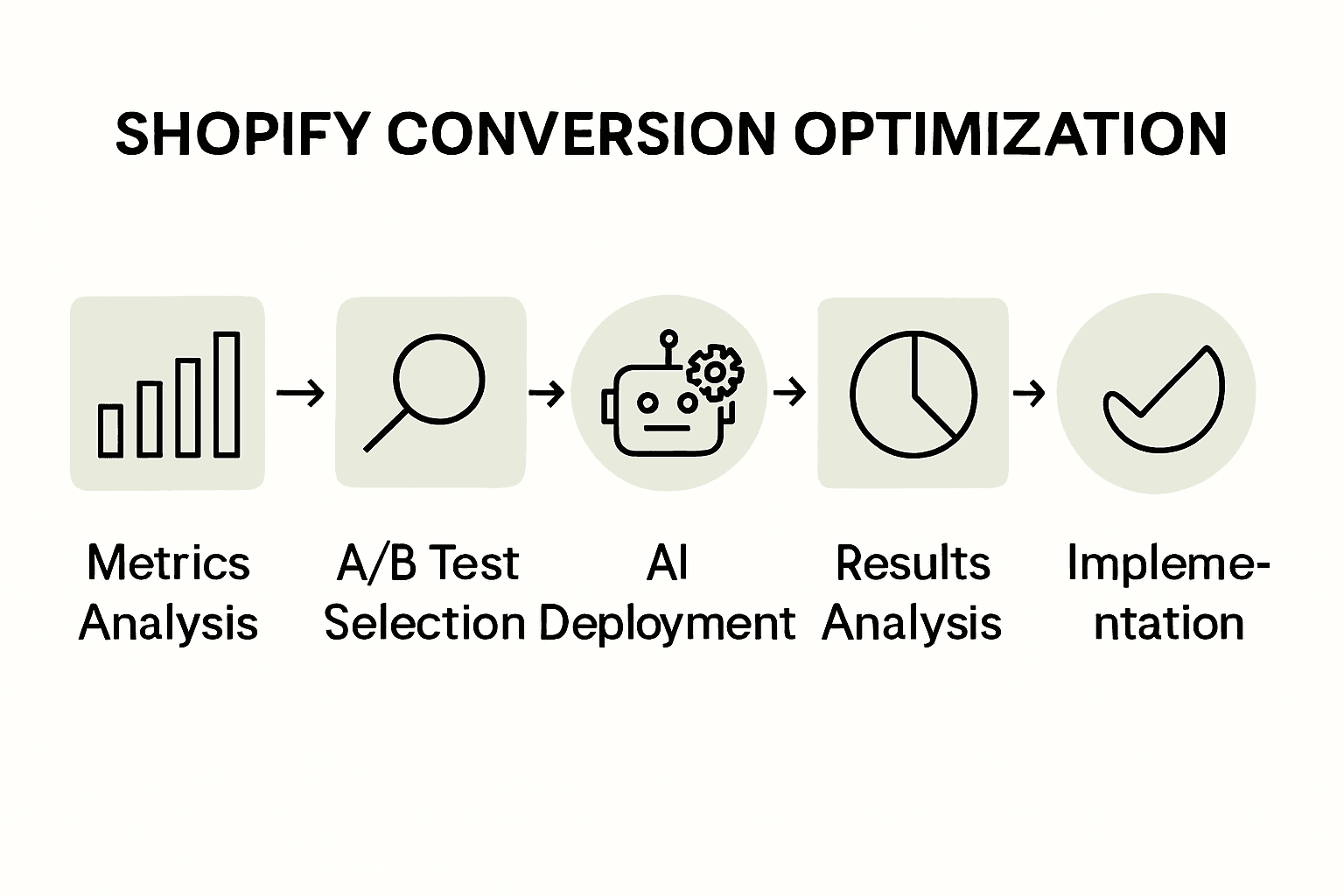
- Step 1: Assess Store Performance And Set Clear Goals
- Step 2: Select High-Impact A/B Tests From The Library
- Step 3: Deploy And Customize Tests With AI Automation
- Step 4: Monitor Results And Analyze Data Insights
- Step 5: Implement Winning Variations For Lasting Gains
Quick Summary
| Key Insight | Explanation |
|---|---|
| 1. Assess Key Performance Metrics | Monitor conversion rate, cart abandonment, and average order value to identify strengths and weaknesses in your store. |
| 2. Choose Effective A/B Tests | Select A/B tests with proven results for similar stores to maximize your conversion rate improvements. |
| 3. Utilize AI for Test Automation | Implement AI automation to streamline A/B testing, saving time while customizing tests to your store’s needs. |
| 4. Analyze Results Critically | Scrutinize test results for statistical significance and ensure improvements are genuinely valuable before applying. |
| 5. Implement Winning Variations | Roll out successful test variations methodically, monitoring their long-term impact across different customer segments. |
Step 1: Assess Store Performance and Set Clear Goals
Converting online shoppers into buyers requires a strategic approach to understanding your Shopify store’s current performance. A comprehensive analysis by BCG examining over 220,000 e-commerce sites reveals that successful conversion optimization starts with rigorous performance assessment.
To begin, you need to dive deep into your Shopify analytics and identify key metrics that reveal your store’s strengths and weaknesses. Focus on critical performance indicators like conversion rate, average order value, cart abandonment rate, and traffic sources. Large scale research by meta analysis of e-commerce A/B tests confirms that precise funnel positioning and experiment characteristics dramatically impact conversion outcomes.
Start by calculating your current conversion rate the percentage of website visitors who complete a purchase. Most Shopify stores average between 1-3%, but top performing stores can reach 5-10%. Analyze where potential customers drop off in your sales funnel by examining each stage carefully. Are they leaving during product selection? At checkout? Understanding these specific points helps you create targeted improvement strategies.
Pro tip: Create a baseline performance dashboard that tracks your most critical metrics weekly. This practice allows you to quickly identify trends and measure the impact of any optimization efforts you implement.
Here’s a summary of key Shopify store performance metrics and their significance:
| Metric | What It Measures | Why It Matters |
|---|---|---|
| Conversion Rate | Percentage of visitors purchasing | Main indicator of store health |
| Average Order Value | Average spend per transaction | Impacts overall revenue |
| Cart Abandonment Rate | Share of visitors leaving at cart | Highlights UX or checkout issues |
| Traffic Sources | Where visitors are coming from | Guides ad and SEO priorities |
Step 2: Select High-Impact A/B Tests from the Library
Selecting the right A/B tests is critical for maximizing your Shopify store’s conversion potential. Research on online controlled experiments reveals the complexity of designing personalized e-commerce optimization strategies, emphasizing the importance of carefully chosen tests that can meaningfully impact your store’s performance.
When browsing the A/B testing library, focus on tests with proven track records of improving conversion rates. Look for variations that have demonstrated significant impact across similar store types and product categories. Academic studies highlight the fundamental challenges of hypothesis testing with finite inventory, which means you should prioritize tests that not only show potential improvement but also account for your specific product constraints.
Start by sorting the available tests by their impact rating and certainty score. Pay close attention to tests that address key conversion bottlenecks like product page layout, checkout process, pricing display, and call-to-action design. Consider your store’s unique characteristics like average order value, product type, and target audience when selecting tests. Not every high-impact test will be equally effective for your specific store, so use the library’s filtering and sorting tools to find the most relevant options.
Pro tip: Before implementing any A/B test, run a quick preliminary analysis of your current metrics to establish a clear baseline. This will help you accurately measure the true impact of each test variation you select from the library.
Step 3: Deploy and Customize Tests with AI Automation
AI automation represents a breakthrough in streamlining A/B testing for Shopify stores. Cutting-edge research introduces advanced self-adaptive micro-service systems designed to automate complex testing processes, enabling store owners to implement sophisticated optimization strategies with minimal technical expertise.
The AI automation process begins by analyzing your store’s unique characteristics and automatically generating customized test variations. Recent developments in AI-powered testing methodologies demonstrate how contextual bandits and intelligent algorithms can optimize user experience, allowing for precise and adaptive testing strategies. The system will automatically adjust code snippets, modify design elements, and create targeted variations that align with your store’s specific conversion goals.

When deploying AI-automated tests, focus on the detailed customization options. Review the proposed variations carefully, ensuring they reflect your brand identity and align with your target audience’s preferences. The AI system will suggest multiple test scenarios, complete with predicted impact scores and recommended implementation strategies. Pay attention to the confidence intervals and potential conversion lift for each proposed variation to make informed decisions about which tests to prioritize.
Pro tip: Always maintain a small percentage of manual oversight during AI-automated testing. While the system provides powerful optimization capabilities, your unique insights about your brand can help fine-tune and validate the proposed testing strategies.
Below is a comparison of manual versus AI-automated A/B testing approaches:
| Approach | Setup Complexity | Speed to Results | Optimization Flexibility |
|---|---|---|---|
| Manual Testing | Requires expertise | Slow, sequential | High customization, hands-on |
| AI Automation | Minimal technical skill | Fast, simultaneous | Contextual, data-driven suggestions |
Step 4: Monitor Results and Analyze Data Insights
Comprehensive research analyzing 2,270 A/B tests reveals critical insights into effective data monitoring and statistical integrity, highlighting the importance of rigorous result analysis in conversion rate optimization. Monitoring your A/B test results requires a systematic approach that goes beyond surface level metrics to understand the true impact of your experiments.
Advanced research examining interference effects in experimental platforms emphasizes the complexity of accurately interpreting test data. Focus on key performance indicators like conversion rate, average order value, and statistical significance. Pay close attention to confidence intervals and potential bias in your results. Look for consistent patterns across different variations rather than relying on isolated data points. Compare the performance of test variations not just in raw conversion rates but in overall revenue impact and long term customer behavior.
Utilize the built-in analytics dashboard to visualize your test results comprehensively. Break down the data by different customer segments, traffic sources, and device types to uncover nuanced insights. Watch for statistically significant variations that demonstrate meaningful improvement. Be prepared to run extended tests if initial results are inconclusive or show marginal differences between variations.
Pro tip: Always maintain a skeptical perspective when analyzing test results. Statistical significance does not guarantee practical significance so critically evaluate whether the observed improvements justify implementing the proposed changes.
Step 5: Implement Winning Variations for Lasting Gains
Research on digital campaign optimization reveals critical strategies for transforming successful A/B test results into sustainable performance improvements, highlighting the importance of strategic implementation beyond initial testing. Implementing winning variations is not just about applying a single successful change but creating a comprehensive approach to continuous store optimization.
Comprehensive e-commerce research underscores the significance of methodically applying test outcomes to enhance user experience. Begin by prioritizing variations that demonstrate statistically significant improvements and align with your broader business objectives. Carefully roll out winning variations incrementally, monitoring their long-term impact on key performance indicators such as conversion rate, average order value, and customer retention. Avoid making multiple simultaneous changes that could muddy your understanding of each variation’s specific contribution.
Consider the broader context of your winning variations. Analyze how they interact with different customer segments, traffic sources, and device types. Some variations might perform exceptionally well for mobile users but show minimal impact on desktop traffic. Create a phased implementation strategy that allows you to validate the consistency and reliability of your test results across various user groups and scenarios.
Pro tip: Document every implementation of a winning variation, including the specific metrics that drove your decision. This historical record will help you build a more nuanced understanding of your store’s optimization journey and provide valuable insights for future testing strategies.
Boost Your Shopify Conversion Rates with AI-Powered Testing
Converting visitors into loyal customers is challenging without precise insights and effective tools. This article highlights the critical steps needed to analyze your Shopify store’s performance and select impactful A/B tests that drive real growth. If you struggle with choosing the right tests or worry about complex implementations, you are not alone. Many Shopify store owners face difficulties identifying conversion bottlenecks and executing tests without technical support.
Automagic.li offers an innovative solution tailored exactly for these challenges. Our platform provides a rich library of high-impact A/B tests curated based on proven effectiveness and certainty scores. You do not need coding skills because our AI-powered system automatically customizes and deploys tests that fit your unique store design, saving you time and eliminating guesswork. This makes optimizing conversion rate, average order value, and cart abandonment rate an achievable goal for any Shopify merchant.
Start your journey to Shopify success now by exploring how easy it is to implement data-driven optimizations with Automagic.li.
Ready to transform your Shopify store’s conversion workflow? Discover the power of AI automation and a ready-to-use A/B test library at Automagic.li. Take the first step toward continuous growth and measurable improvements. Visit Automagic.li today and see how effortless conversion optimization can be.
Frequently Asked Questions
How can I assess my Shopify store’s current conversion rate?
To assess your Shopify store’s current conversion rate, divide the number of completed purchases by the total number of visitors during a specific timeframe. Track this metric weekly using a performance dashboard to identify trends and areas for improvement.
What key performance indicators should I focus on for conversion rate optimization?
You should focus on conversion rate, average order value, cart abandonment rate, and traffic sources. By analyzing these metrics, you can pinpoint where customers may be dropping off and adjust your strategies accordingly.
How do I select the right A/B tests for my Shopify store?
Choose A/B tests with proven success rates that align with specific areas of your store needing improvement. Sort available tests by their impact rating, focusing on those targeting key conversion bottlenecks such as the checkout process or product page layout.
What steps should I take to implement AI automation in my A/B testing?
Begin by leveraging AI automation tools to analyze your store’s characteristics and suggest customized test variations. Review proposed scenarios thoroughly to ensure they match your brand identity and contribute to your conversion goals.
How can I analyze the results of my A/B tests effectively?
Analyze A/B test results by focusing on key metrics like conversion rates and average order value, while looking for statistically significant improvements. Use your analytics dashboard to visualize data across different customer segments, ensuring your insights are granular and actionable.
What should I consider when implementing winning variations?
When implementing winning variations, prioritize those that show statistically significant improvements and align with your business goals. Roll them out incrementally and document each change to build a historical record of your optimization efforts.